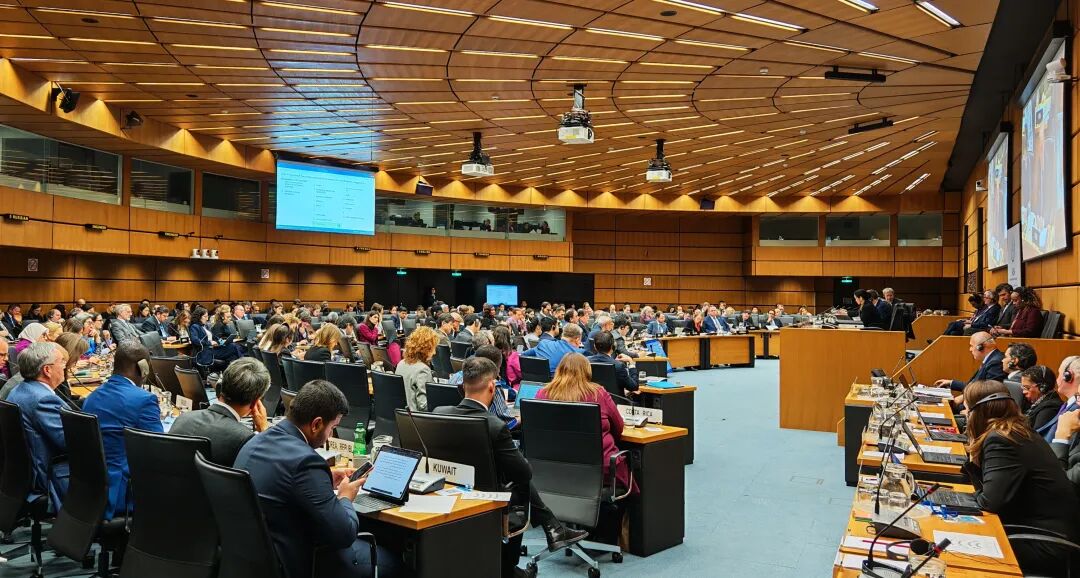
H.E. Ambassador Li Song’s Keynote Remarks and statements exercising right of reply at the November Board of Governors Meeting of the International Atomic Energy Agency on AUKUS
H.E. Ambassador Li Song's keynote Remarks under the agenda item on AUKUS nuclear submarine cooperation requested by China at the November Board of Governors meeting of the International Atomic Energy Agency
(20 November 2025)
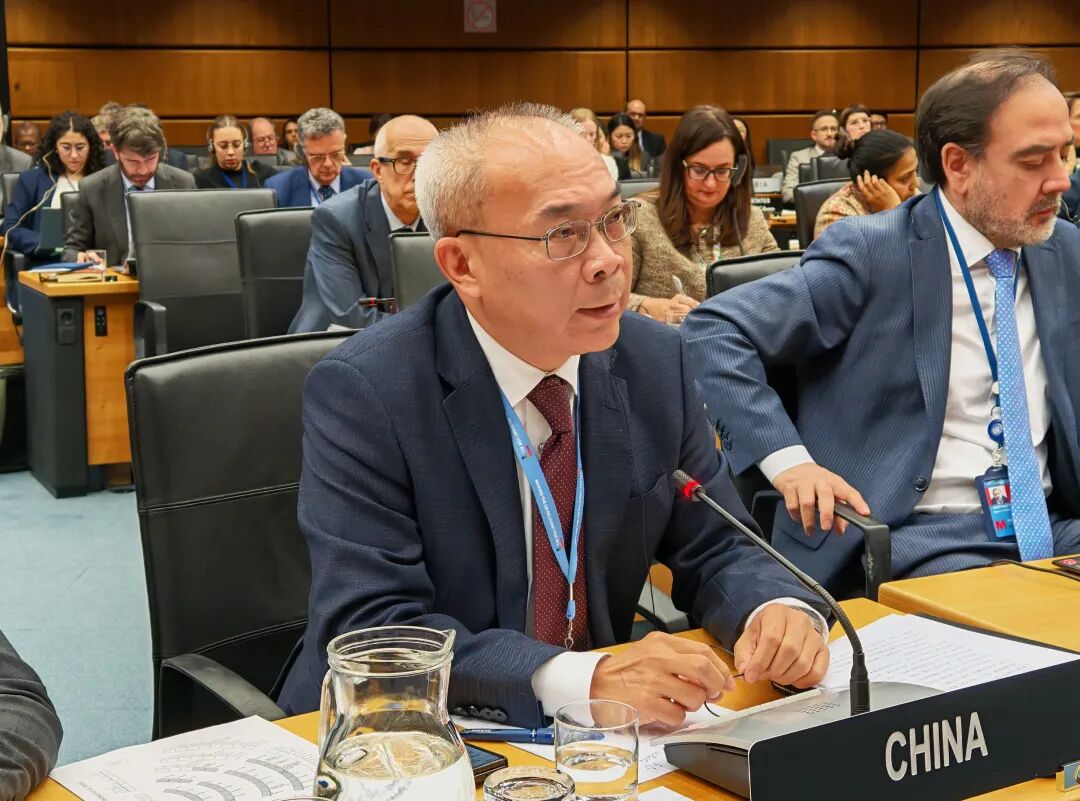
Mr. Chair,
At the November Board of Governors meeting of the International Atomic Energy Agency (IAEA) four years ago, the Chinese delegation for the first time proposed including “issues related to the transfer of nuclear materials and safeguards supervision involved in the US-UK-Australia nuclear submarine cooperation, and their implications for various aspects of the Treaty on the Non-Proliferation of Nuclear Weapons (NPT)” on the agenda of IAEA formal meeting. Practice has shown that such intergovernmental discussions are necessary and effective; they are crucial for upholding principles, clarifying the facts, safeguarding the NPT regime, and preventing the IAEA from being misled or exploited.
AUKUS is clearly not a peaceful cooperation on nuclear energy in the traditional sense, just as a tiger cannot be called a cat. From the very first day Australia the UK and the US announced their AUKUS cooperation, China pointed out incisively that this is a textbook case of nuclear proliferation. The core purpose and objective of the NPT is to maintain global and regional peace and stability by preventing nuclear proliferation. If nuclear-weapon states and non-nuclear-weapon states, through military alliances and for geopolitical and strategic military purposes, extend their strategic nuclear cooperation beyond the scope that the NPT has upheld for half a century, would that not amount to crossing the threshold of nuclear proliferation?
Safeguards over AUKUS cooperation is not routine safeguards and is fundamentally different from the hundreds of safeguards programs implemented by the IAEA. In fact, IAEA has never implemented safeguards on any nuclear submarine of Nuclear-Weapon-States, let alone on safeguards on a nuclear submarine cooperation project between Nuclear-Weapon-States and Non-Nuclear-Weapon-State. Therefore, AUKUS related safeguards obligations and arrangements will certainly bring safeguards practice into unprecedented territory, thus setting an important precedent and having a significant impact on the development and improvement of safeguards regime. Based on existing practices and regulations, IAEA secretariat is not in a position to provide a comprehensive, objective, scientific, and convincing answer on AUKUS safeguards. Also, no single state has the authority to dictate rules to the IAEA and other Member States on these issues.
As many have noticed, several countries in the Asia-Pacific region have recently expressed strong interest in developing nuclear submarines. Right-wing forces in one country even claimed their intentions to break the "Three Non-Nuclear Principles". These are all military allies of a superpower. It seems that the issue of "nuclear submarine proliferation" will become an increasingly significant challenge for the international community and the NPT regime.
Australia, the US and UK claim that the IAEA can only discuss technical issues and not political ones. They consistently label countries that express differing opinions on AUKUS as politicizing the issue. In response, I must point out that the IAEA, as a crucial international organization for maintaining the NPT regime and promoting cooperation in the peaceful uses of nuclear energy and nuclear technology, deals with many issues that involve significant political principles. Member States must always view and address major challenges like AUKUS from a political and strategic perspective. Resisting intergovernmental discussions, suppressing dissenting opinions, seeking special exceptions, engaging in bloc confrontation, and taking sides are blatant politicization. Member states should resist such behavior, and the Secretariat must be highly vigilant.
Throughout the IAEA's history, the improvement and development of the IAEA safeguards regime has always relied on universal participation, joint efforts and consensual endorsement among Member States. How we are viewing and handling the AUKUS safeguards issue is related to the integrity, effectiveness and future applicability of the comprehensive safeguards system and is closely related to the common interests of all Member States. Everyone has a voice, and we should jointly study and decide on the matter. Defending the historical tradition of the development and improvement of the comprehensive safeguards system should be regarded as the most important political principle of the IAEA. If this tradition is challenged or even undermined by AUKUS, causing divisions among Member States, it will inevitably have an immeasurable and profound negative impact on the IAEA's safeguards system and the NPT regime. No one can afford such a historical responsibility, and the AUKUS partners should think twice.
Mr. Chair,
In actively promoting intergovernmental discussions on AUKUS, China has consistently advocated for sovereign equality, adherence to international rule of law, and the practice of multilateralism. It has stayed committed to the vision of common, comprehensive, cooperative and sustainable security, prioritized the legitimate security concerns of all countries, and insisted on resolving differences between countries through dialogue and consultation, rather than conflict and confrontation. These are the key concepts fully embodied in the Global Governance Initiative and Global Security Initiative put forward by President Xi Jinping. Adhering to these principles serves the common interests of all Member States and is essential for upholding the international nuclear non-proliferation regime.
Given the long-term, complex, controversial, and uncertain nature of AUKUS cooperation, the IAEA must handle AUKUS issues in the most cautious, responsible, and prudent manner. China advocates that Member States adhere to the principles of seeking common ground while shelving differences, taking a long-term approach, maintaining unity, and avoiding division, and continue to engage in open, inclusive, democratic, transparent, meaningful, and sustainable intergovernmental discussions on all aspects of the AUKUS issue based on equality and mutual respect, gradually explore solutions that will be agreed upon by all Member States and that will stand the test of time and practice.
China respects and supports the Secretariat in carrying out its mandate in accordance with the Statute. At the same time, China hopes that the Secretariat will fully recognize the complexity and sensitivity of the AUKUS issue, fully respect and carefully listen to the different opinions of Member States, objectively reflect the progress of intergovernmental discussions, especially the differences among the parties, and assist intergovernmental discussions with a scientific and professional attitude.
China is willing to work with all parties to continue to actively participate in and promote the intergovernmental discussion process on all aspects of AUKUS, with a view to contributing to the maintenance of the international nuclear non-proliferation regime.
Thank you.
H.E. Ambassador Li Song’s Statement Exercising the Right of Reply in Response to Threats to Block China’s Agenda Item at the November Board of Governors Meeting of the International Atomic Energy Agency
(20 November 2025)
China appreciates the different views and opinions expressed by various Member States on the AUKUS issue, which all constitute contributions to the intergovernmental discussions on AUKUS. Over the past four years, the Chinese delegation has consistently communicated with the Secretariat and relevant parties in a rational, professional, and responsible manner. The positive results of the intergovernmental discussion process are evident. The IAEA Board of Governors should be a forum for reasoned discussion, not quarrels. Member States should take the maintenance of the NPT regime and the integrity of the IAEA safeguards system as a common goal, and engage in full and substantive exchanges of views on all aspects of safeguards related to AUKUS.
Australia, the US, and the UK have labeled China’s actions of “politicization.” On this point, I must emphasize: refusing to listen to differing opinions, denying others the opportunity to speak, blatantly rejecting multilateral discussions, and forcing Member States to take sides—that is true politicization. Attempting to use their majority seats in the IAEA Board of Governors to obstruct the intergovernmental discussion process is nothing less than complete politicization.
China has also noted that Australia, the US, and the UK in their statements, have hinted at taking action against China’s agenda item. Over the past four years, they have made such threats multiple times. I must stress that, according to the Board’s rules of procedure, any IAEA Member State has the right to request the inclusion of any important agenda item for the Board’s consideration. In the history of the IAEA, there has never been a case in which a Member State’s proposed agenda item was blocked through voting or other means. The claim by the US, UK, and Australia that they can block China’s agenda item constitutes a flagrant challenge to the Board’s rules of procedure, the legitimate and equal rights of Member States, the principles of mutual respect and democratic practice in the IAEA’s work, and the tradition of consensus-based decision-making. It severely undermines the working atmosphere of the Board. IAEA Member States should firmly oppose and jointly resist such hegemonic and overbearing behavior. We urge the parties concerned not to attempt to provoke confrontation or create division. Such attempts will not succeed.
H.E. Ambassador Li Song's Statement Exercising the Right of Reply Under the Agenda Item "Naval Nuclear Propulsion: Australia" at the November Board of Governors Meeting of the International Atomic Energy Agency
(20 November 2025)
Mr. Chair,
The Chinese delegation takes note of the DG's report on AUKUS and listened carefully to all statements. I am requesting the right of reply to make the following three points.
First, China not in favor of discussing the AUKUS issue under the title "Naval Nuclear Propulsion: Australia". This is our consistent position. AUKUS is by no means a routine cooperation project on the peaceful use of nuclear energy. It is fundamentally different from the hundreds and thousands of peaceful nuclear projects conducted by Member States since the IAEA's establishment. Australia, the US, and the UK packaged AUKUS as a peaceful nuclear cooperation project, which is just like covering one's ears while attempting to steal the bell. As is well known, AUKUS is a strategic military cooperation between two Nuclear-Weapon states and their non-Nuclear-Weapon military ally, which involves the transfer of tons of weapons-grade highly enriched uranium (HEU). From the perspective of its purpose, nature, and the activities involving the transfer of weapons-grade nuclear material, this cooperation is unprecedented, and falls outside the coverage of the IAEA's current safeguards regime. It is highly controversial.
For the above reasons, over the past 4 years, China has consistently raised the agenda item, which requests reviewing AUKUS from a non-proliferation perspective at each IAEA Board of Governors meeting and General Conference. The agenda item "Naval Nuclear Propulsion: Australia" does not accurately reflect the nature and the significant controversies of the AUKUS submarine cooperation. China has made clear reservations on this matter, and thus we disassociate from this wording.
Second, the report submitted by the DG on AUKUS does not comprehensively and objectively reflect the intergovernmental discussions among IAEA Member States on AUKUS. We express deep concern and dissatisfaction with this.
Over the past four years, with the active engagement of Member States, intergovernmental discussions on the AUKUS issue within the IAEA framework have continued to deepen. For three consecutive years, China has convened AUKUS-related workshops at the VIC, bringing together IAEA Member States, the Secretariat, as well as experts and scholars from various think tanks. China, numerous other Member States, and even Australia have presented differing views at these events—fully reflecting the diversity of intergovernmental perspectives and the complexity and contentious nature of the AUKUS issue—and further fostering understanding and reflection among Member States. The Director General’s decision to overlook these significant developments in his report is both unusual and inappropriate.
The discussions and different opinions that have arisen in previous Board of Governors meetings and General Conference, have already, and will continue to, form an important part of IAEA Member States' deliberations of AUKUS related nuclear proliferation and safeguards issues. They are consistently reflected in the records and the chair's summaries of past meetings. Summary of three AUKUS workshops hosted by China were also circulated as INFCIRC documents. These are undeniable facts and ongoing history, which will become an important chapter in the history of the IAEA. We continue to call on the DG and the Secretariat to treat the intergovernmental discussions with an objective and impartial attitude. Only in such a way can the Secretariat demonstrate its independence and professionalism.
Third, Article 14 of any CSA has never made any clear provisions for such cooperation as AUKUS. The safeguards involved in this cooperation constitute one of the most contentious and challenging issues under the IAEA’s comprehensive safeguards system. It is not something that can be handled or resolved through private deals between the Australia, the US, the UK, and the Secretariat. The AUKUS partners claim that safeguards arrangements between them and the Secretariat will set the "strongest precedent" and the "highest standard" for non-proliferation. But I ask, who gave you the right to set such "precedents" and "standards" for other Member States? The Secretariat said that it has the "technical capacity". But I ask, since the IAEA has never carried out safeguards on nuclear-powered submarines, nor has it ever engaged in related cooperation with Nuclear-Weapon states, where does the so-called "technical capacity" come from?
AUKUS involves the transfer of tons of weapons-grade highly enriched uranium and raises numerous complex political, legal, procedural, and technical issues. It also involves safeguard obligations that Australia, as a non-Nuclear-Weapon state, and the United States and the United Kingdom, as Nuclear-Weapon states, have never previously undertaken. No one can provide answers to these questions now, just as no one can predict the future of AUKUS. AUKUS is not a simple routine safeguards issue, nor can it be solved casually. Such complex issues can only be resolved through patient and careful intergovernmental discussions among all IAEA Member States, especially those that are interested and concerned, to arrive at a solid, credible, mature, reliable, universally accepted, and time-tested solution. We hope that DG and the Secretariat will play an independent, professional, and constructive supporting role in future intergovernmental discussions.
This is why China requests this Board session to continue to set a separate formal agenda item on the AUKUS issue, focusing on the transfer of weapons-grade nuclear materials involved in the AUKUS cooperation. I will further elaborate China's position under agenda item 7, and welcome IAEA Member States including AUKUS partners to participate in the discussion.
Thank you.